

By Andrea Laine, a Master Gardener℠ volunteer with NC State Extension
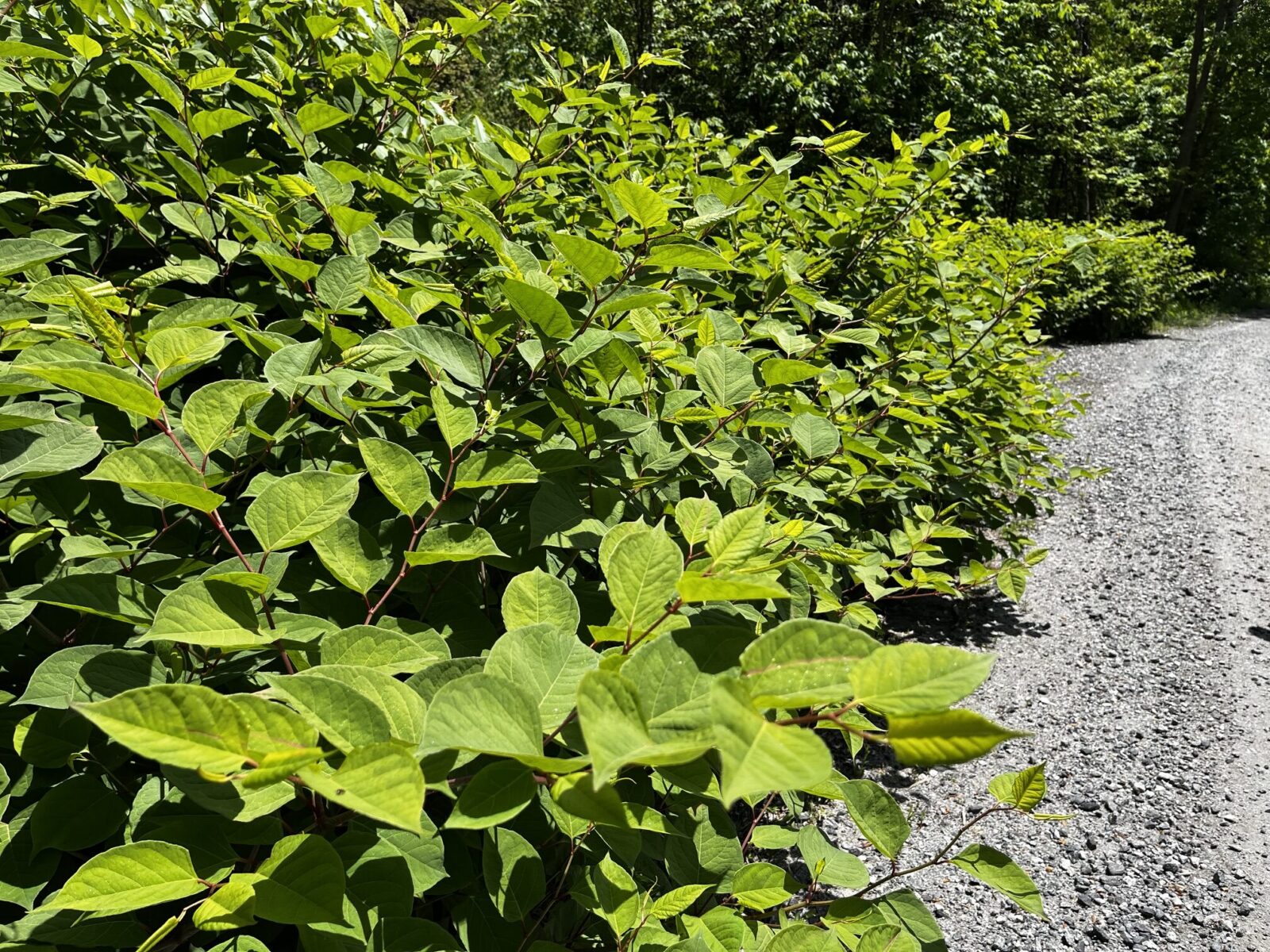
Japanese Knotweed (Reynoutria japonica) has become as ubiquitous to the banks of local waterways as Chinese silver grass (Miscanthus sinensis) is to highway embankments. Both are invasive species in North Carolina which means they know no boundaries and may quickly overtake other plant species (native or exotic), reduce biodiversity, and disrupt an ecosystem. Invasive species can accomplish this takeover because they have no predators here in North Carolina. When predators such as insects, fungi, and other wildlife feed on plants they effectively keep that plant in check and the ecosystem in which it grows balanced.
With patience and persistence, you can control knotweed. Left unmanaged, it will outcompete other vegetation and may someday be the only plant in your landscape. At that point, it may be beyond control. So why not get it before it gets completely out of hand?
Identify it Correctly
The first step is to make sure you’ve identified it correctly, so bear with me while I describe knotweed in some detail.
Japanese knotweed is an herbaceous perennial that grows up to 10 to 13 feet tall in one year and forms dense stands. Its upright stems are hollow and resemble bamboo. The leaves are heart to triangular shaped and are alternately arranged on the stem. Knotweed flowers in late summer to fall. Japanese knotweed is an annual; it dies to the ground in winter. New growth is reddish-brown. It has vigorous rhizomes which aid its spread enabling it to colonize roadsides and creek banks. Cut or broken stems will root if left on moist soil or put directly into water. Water also helps disperse the seeds.
Begin Control in June
June is the optimal time to begin control. Cut the stalks down to a couple of inches and wait at least eight weeks before treating the foliage with a systemic herbicide. (Yes, herbicide. Successful treatment of invasive plant species will almost always require herbicide use.)
Cutting reduces rhizome growth and the height of stem regrowth so it will be easier to target the plant with herbicide. Targeting is important so that you only spray the knotweed. Timing is also very important! Applications of herbicide made too early in the growing season or too soon after cutting only injure the shoots and not the rhizomes. Later in the growing season is when the foliage is sending sugars to the rhizomes and so spraying the leaves with systemic herbicide then has the greatest impact. Ideally, this will be before the plants flower thus minimizing harm to honeybees and other pollinators.
Collect and bag the cut stems and dispose of them with your trash. Do not compost them or your next patch of knotweed may be in the compost pile!
Herbicide is the Only Way
NC Extension recommends applying 41% active formulation of glyphosate at a 2% rate. If you can’t find this at a garden center, ask at your local general store if they will order it for you. You’ll want to add a surfactant to the solution if your knotweed is growing in or near a creek, river or other waterway. The surfactant will help the solution stay on the leaves you sprayed. Read more about Extension’s recommendation at this link: https://content.ces.ncsu.edu/postemergence-non-selective-herbicides-for-landscapes-and-nurseries Always read and follow instructions on the herbicide container. Wear a long-sleeved shirt, long pants, socks and closed toe shoes.
Ecoforesters, a nonprofit organization in Asheville, recently published a very good 20-minute video about identifying and controlling invasive species. They recommend a combination of herbicides. I followed Extension’s advice a few years ago (using one herbicide) and got rid of a dense patch of knotweed on my land. You decide what’s best for you. Here’s the link to the Ecoforester video. Knotweed is addressed at 10 minutes 22 seconds: https://www.youtube.com/watch?v=12OX2wTWskk&t=1s
Ridding your landscape of an invasive species may not be a one and done endeavor. You may need to treat the area again. But success is possible and worthwhile. Nature is counting on you!
One more thing
Below are suggestions for what to plant in place of the knotweed, once you are sure you have removed it all.
- (Arundinaria gigantea) river cane
- (Cornus amomum) silky dogwood *pollinator support
- (Sambucus canadensis) elderberry *pollinator support
- (Salix nigra) black willow *important spring pollinator support
- (Carex spp.) native sedges
- (Panicum virgatum) switchgrass, *note that switchgrasses are highly flammable and should not be planted within 100 feet of structures.
Consult the NC Extension Gardener Plant Toolbox to learn more about these plants.
Comments are closed